
Why People Still Win in B2B

INSIGHT - HELEN BLAKE
I know I’ve been saying this for years, and I make no apology for saying it again. Your customers don’t just buy what you sell. They buy the experience of dealing with your people.
Trust me, I know it’s tempting to believe that business-to-business purchasing is a purely rational exercise: functionality, price, a signed contract. The reality is that anyone who has bought either products or services knows that when the product/service offered by two or more companies is comparable and the price is close enough, the decision often comes down to who you trust to answer the phone when something goes wrong.
Business buyers are people first
Research by CEB (now Gartner) with Google and Motista surveyed more than 3,000 B2B buyers. Seven of the nine B2B brands studied in depth held an emotional connection with over half their customers. Emotional value - such as confidence - or social value - such as looking good to colleagues - had twice the commercial impact of rational business value. As Martha Mathers wrote of the findings, "Customers aren't predictable, perfectly rational machines." The reason why is risk: a bad choice of company supplier will cost them their reputation (and possibly their job).
Salesforce's State of the Connected Customer research found that four in five customers weigh the experience of dealing with a company as heavily as product quality, with business buyers higher still.
At Futurecurve, we see this with each and every client we work with.
And it’s still true even in an age of AI. Gartner's 2026 research found 69% of buyers still turn to a sales professional to validate what AI has told them.
Every customer-facing role is a relationship role
Relationships remain vital. Sales or Business Development may open the door, but Operations and Customer Service decide whether the customer stays. Every single touchpoint that the customer has of working with you will inform whether or not you really do care about their value experiences. Things like each delivery, invoice, query and complaint provides evidence of whether your promises were real.
The customer remembers the person who knew their account history without being told it twice. They also remember the opposite. Gartner found that buying groups who spent more time with supplier representatives reported the least internal dysfunction. These groups were also 13 times more likely to report a high-quality contractual agreement.
Human contact does not slow decisions down; it gives people the confidence to make them.
Putting it into practice
Here’s what I suggest you do after you’ve won that important piece of work:
Track the moments that matter after the sale, not just before it: onboarding, first delivery, the first problem
Give clearly identified people ownership. Customers trust a person more than the technology
But - use technology to remove friction, not to remove people from moments that need reassurance.
Measure relationship health across sales, operations and service
Your value proposition needs to be compelling enough to get you noticed and on a customer’s shortlist. It’s your people that get you chosen and keep that customer loyal.
This is why your value proposition has to be built with rational AND emotional AND social value factors.
The Value Proposition Builder™ six-step methodology incorporates all this. It includes market trend analysis; a series of qualitative interviews - engaging customers in rich conversations about their experiences of working with you and the value experienced; and a value hierarchy assessment of product and service offers.
Bringing it all together delivers a deeper understanding of authentic customer value. It is directly involved in revitalising and aligning teams both inside and outside the business. Increasing differentiation and avoiding commoditisation comes from ensuring the value to the customer is both clear and real, leading to useable, actionable business strategies.
Our clients win better and more profitable business, faster and more sustainably based on the difference they make to their customers. People remain at the heart of this difference.
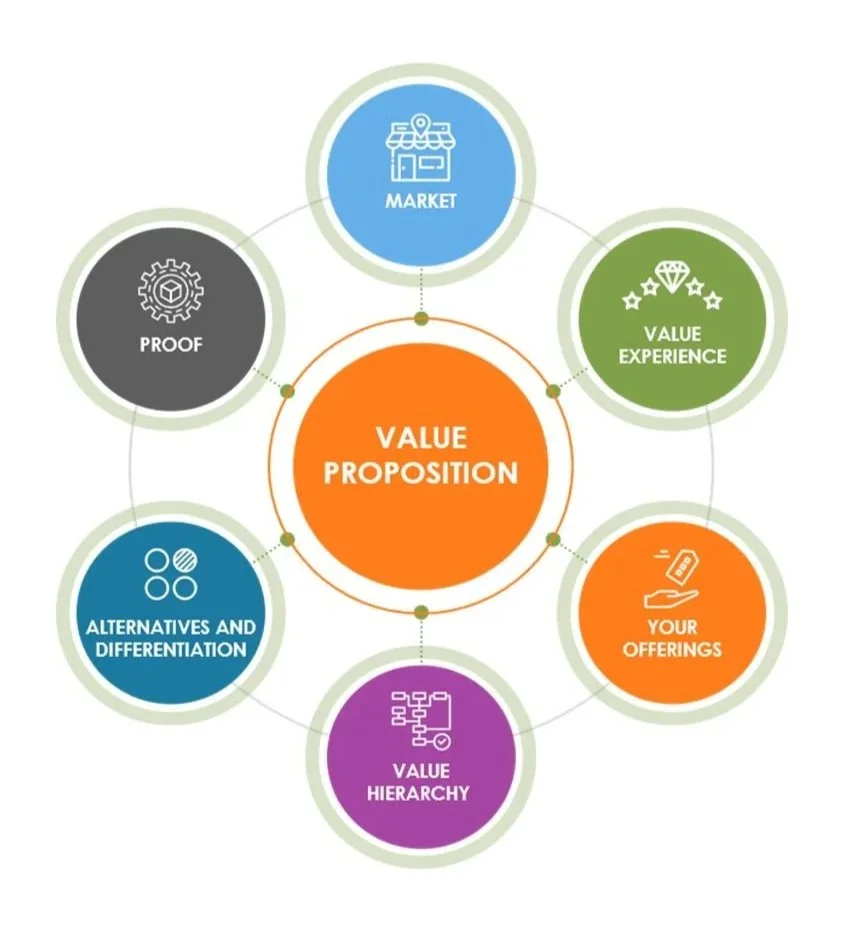
The Value Proposition Builder™. ©Helen Blake/Futurecurve. All rights reserved.